
Get Healthy!
- Posted January 9, 2026
What Is CPR and Who Needs It?
Cardiopulmonary resuscitation (CPR) is a vital skill anyone can perform. It is administered to an unconscious person who is not breathing normally.
More than 70% of out-of-hospital cardiac arrests happen at home, according to the 2024 Cardiac Arrest Registry to Enhance Survival (CARES) Annual Report, and nationwide, 41.7% of patients receive bystander CPR.
Bystander CPR can double or even triple the chances of survival during an out-of-hospital cardiac arrest. Hands-only CPR is an effective treatment anyone can perform until emergency services arrive.
What is a cardiac arrest?
A cardiac arrest occurs when the heart stops beating. This prevents the heart from pumping blood to the brain and other parts of the body, causing a sudden collapse. Without immediate intervention, such as CPR, survival rates are incredibly low.
What is hands-only CPR, and how does it work?
Hands-only CPR is performed by compressing the chest only, with no rescue breaths or mouth-to-mouth resuscitation.
Your heart is located behind your breastbone (sternum). The ribs attach to the sternum by cartilage, similar to the cartilage in the top of your ear. This cartilage allows your chest to expand and move.
Your heart has an electrical system, which generates signals that produce the heartbeat, and a plumbing system (arteries and veins) that transports blood and oxygen throughout the body. When your heart stops pumping due to an electrical or plumbing issue, we begin hands-only CPR.
Did you know that your heart can stop pumping, and it may still look like someone is breathing?
This phenomenon occurs because your brain, which controls breathing, did not receive the message that the heart has stopped.
This type of gasping or noisy breathing, called agonal breathing, is not life-sustaining. Agonal breathing can last from a few seconds to several minutes after the heart has stopped pumping. “Normal” breathing is effortless and is how most people breathe every day.
What is the purpose of CPR? The purpose of CPR is to apply pressure to an individual’s sternum (breastbone) so that the heart is compressed between the breastbone and spine.
This action helps to pump blood throughout the body. Your hands press down on the sternum, acting as an external pump until the heart’s function can be restored.
When should I begin CPR?
Begin CPR if a person is unresponsive -- not awake -- and not breathing normally. Call 911 and place your phone on speaker. The 911 operator will provide instructions until help arrives.
How do I perform CPR?
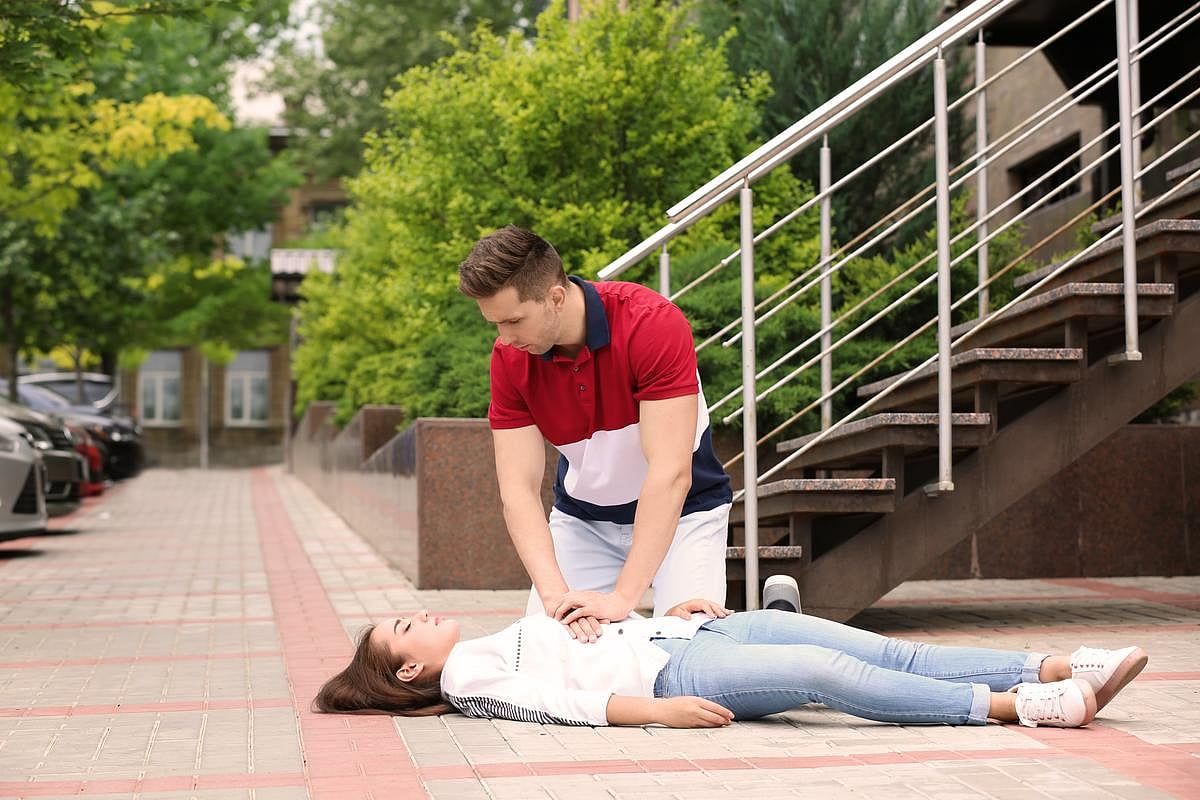
First, lay the person flat on their back. Kneel beside them and place your hands, one on top of the other, on the center of the breastbone. The bottom, or heel of your hand should be roughly even with the nipples.
Push down firmly, about one-third the thickness of the chest or 2 inches in an adult. Allow the chest to rise naturally after each push. Continue chest compressions at a rate of 100 to 120 beats per minute.
To be prepared before an emergency occurs, can find a list of free CPR songs on Spotify and other music platforms, and you can also download free metronome apps to help maintain the rhythm.
To maintain a rate of 100-120 beats per minute, push hard and fast to songs such as “Stayin’ Alive” by the Bee Gees, “Dynamite” by BTS, or “Dance the Night” by Dua Lipa.
What is an Automatic External Defibrillator (AED) and how does it work?
An AED uses a set of pads to detect a person's electrical heart rhythm. Anyone can operate an AED. If an AED is located nearby during a cardiac arrest, ask another bystander (if available) to retrieve it after you have called 911 and while you continue CPR.
All AEDs include visual (pictures) and auditory (sound) instructions that guide users step-by-step. The AED analyzes a person’s heart rhythm through the pads and decides if a shock is necessary. If a shock is needed, you press a button that delivers an electrical shock to restore the heart's natural rhythm.
It is important not to touch the person while the AED is analyzing the heart rhythm or delivering a shock; any contact can interfere with the device's ability to analyze the rhythm. Whether or not a shock is needed, the AED will also instruct you to begin CPR.
CPR Facts
What if I am wrong and they did not need CPR? In the United States, people are protected by Good Samaritan Laws. These laws offer legal protection to those who voluntarily provide CPR or other emergency aid.
Don’t CPR compressions hurt the person? Someone whose heart has stopped and who is not breathing normally is dead; you cannot make the situation worse.
Do I place my hands differently if the person is female? Your hand placement remains the same for all individuals.
Do I need training before using an AED? No medical training is necessary to use an AED. AEDs are designed to be used by laypersons or non-medical personnel. The U.S. Food and Drug Administration (FDA) has found that a combination of early CPR and defibrillation is effective in saving lives within minutes after a collapse from cardiac arrest.
Do I need to remove clothing to perform CPR or use an AED? CPR can be performed effectively over a person’s shirt or apparel. AED pads must be placed directly on bare skin. However, AED pads can be placed under a bra strap, and it is not necessary to remove a woman’s bra.
Should I take time to learn CPR? CPR is easy to learn, and being prepared can save a life. Even taking a few minutes to learn can make a life-saving difference.
There are plenty of videos to watch and more formal courses available if you want to learn more, you can visitt:
About the expert
Elizabeth Froelich, a retired paramedic ambulance commander from the Chicago Fire Department, has over 30 years of experience in emergency medical care, emergency management, public health and healthcare policy. Elizabeth is the data manager for Illinois Heart Rescue (ILHR) and the Illinois state coordinator for the Cardiac Arrest Registry to Enhance Survival (CARES) at the University of Illinois, Chicago.


